
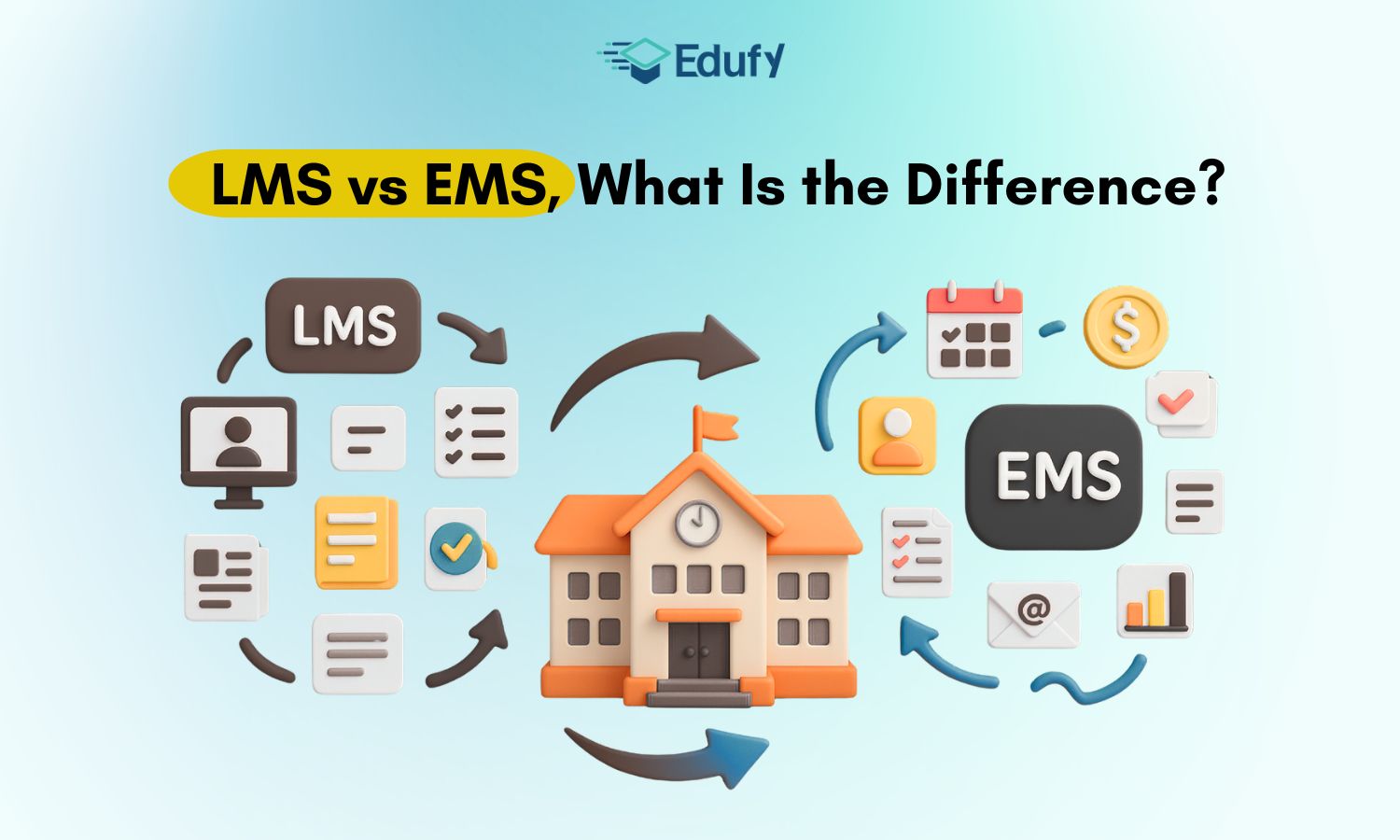
Schools today rely on digital systems to manage both operations and learning. Two of the most commonly used solutions are the Education Management System (EMS) and the Learning Management System (LMS).
An EMS is designed to handle the administrative side of a school, including attendance, fees, reports, and communication. An LMS focuses on the learning experience, allowing teachers to share lessons, assign work, and track student progress.
Because both systems play important roles, many schools find it confusing to decide which one they actually need. Some assume one can replace the other, while others invest in both without fully understanding how they work together.
This guide breaks down the difference between LMS and EMS, explains how each system is used in real school environments, and helps you decide which solution is the right fit for your institution.
Before going deeper, here’s the key difference:
The difference between LMS and EMS is that an LMS focuses on teaching and learning activities such as lessons, assignments, and student progress, while an EMS manages school operations like attendance, fees, reporting, and communication. Most modern schools need both systems to manage academics and administration effectively.
An Education Management System focuses on the administrative and operational side of running a school. It helps principals, teachers, and administrative staff manage daily activities such as attendance, fees, reporting, communication, and student records.
Everything that keeps a school organized is handled within an EMS. It improves accuracy, reduces manual work, and connects different departments through a single system.
Common EMS functions include:
An EMS does not replace teaching. It builds the structure that allows teaching and learning to run smoothly.
A Learning Management System focuses on teaching and learning activities. It allows teachers to deliver lessons, assign work, evaluate student performance, and interact with learners in a digital environment.
LMS platforms are especially useful in online and blended learning setups. They enable students to access study materials from anywhere, submit assignments digitally, and track their academic progress over time.
Typical LMS features include:
An LMS becomes essential when schools offer online classes, remote learning, or need to provide students with flexible access to educational content beyond the classroom.
The simplest way to understand the difference is this: An EMS manages school operations, while an LMS manages the learning process.
| Aspect | EMS | LMS |
| Primary Focus | Administration, coordination, and data management | Teaching, content delivery, and learning progress |
| Users | Administrators, teachers, accounts team, parents | Teachers, students, academic coordinators |
| Core Tasks | Attendance, fees, reports, communication | Courses, assignments, grading, feedback |
| Data Handling | Centralized student and institutional data | Academic content and learning records |
| Integration Capability | Can integrate with learning modules or other tools | Often needs integration with administrative systems |
| Use Case Scenario | Managing school operations efficiently | Delivering and managing digital learning |
| Outcome | Organized workflow and operational efficiency | Improved engagement and academic tracking |
Most schools in Bangladesh used to install separate software for each function — one for administration and another for e-learning. But that approach creates double work, duplicate data, and higher costs.
That’s why Edufy integrates both systems into one unified environment.
Choosing between LMS and EMS depends on how a school operates and what its priorities are.
An EMS alone may be sufficient for schools that:
An LMS may work independently in cases such as:
Most modern schools benefit from using both systems together, especially when they:
Using both systems ensures that learning and management stay connected, reducing gaps and improving overall efficiency.
Using separate systems for management and learning may seem flexible at first, but it often leads to practical challenges over time.
Schools may need to enter the same data in multiple places, which increases the risk of errors and inconsistencies. Reports generated from different systems may not align, making it harder to get a clear picture of performance.
Teachers and staff also spend more time switching between platforms, which affects productivity. For students and parents, managing multiple logins and portals can create confusion and reduce engagement.
In many cases, maintaining separate systems also increases overall costs due to multiple subscriptions, training requirements, and technical support.
Because of these challenges, many schools start looking for more connected and efficient ways to manage both administration and learning together.
Managing learning and administration separately often creates gaps in data, communication, and workflow. An integrated system brings both functions into a single environment, allowing schools to operate more efficiently.
Instead of switching between platforms, teachers can manage attendance, assignments, and student performance from one place. Administrative data and academic records stay connected, which improves accuracy and reduces duplicate work.
A unified system also simplifies access for students and parents. They can check attendance, assignments, results, and notifications without navigating multiple portals.
Platforms like Edufy combine EMS and LMS capabilities into one dashboard, helping schools manage operations and learning together while keeping everything synchronized.
With features for assignments, attendance, communication, and progress tracking, Edufy helps schools deliver a complete educational experience without relying on multiple tools. It’s the modern approach to managing and learning - all in one place.
Using separate systems often means higher costs for licensing, setup, and maintenance. It also requires additional time for staff training and system management.
An integrated solution reduces these overheads by combining all essential functions into a single platform. Schools can streamline operations while minimizing technical complexity and recurring expenses.
Teachers benefit significantly from having both administrative and academic tools in one place. Instead of handling multiple systems, they can manage attendance, assignments, and communication from a single interface.
This reduces repetitive tasks and allows teachers to spend more time focusing on students rather than administrative work.
Students gain more flexibility when learning resources and academic records are easily accessible. They can review lessons, submit assignments, and track their progress without relying entirely on classroom time.
This approach supports both traditional and blended learning environments, making education more accessible and consistent.
When choosing between LMS and EMS or deciding on an integrated system, schools in Bangladesh should consider a few practical factors.
Internet connectivity can vary across regions, so systems that support offline functionality or automatic syncing can be more reliable. Data security is also important, as schools handle sensitive student and financial information.
Ease of use plays a major role in adoption. Teachers and staff should be able to learn and use the system without extensive technical training.
Scalability is another factor, especially for growing institutions that need a system capable of handling increasing data and users over time.
LMS and EMS serve different purposes within a school environment. An EMS manages operations such as attendance, fees, and reporting, while an LMS focuses on teaching, learning, and student engagement.
Schools that rely mainly on traditional classroom teaching may prioritize an EMS, while institutions offering online or blended learning benefit from using both systems together.
As schools grow and digital adoption increases, managing separate platforms can become inefficient. This is why many institutions are moving toward integrated solutions that combine both management and learning capabilities.
Platforms like Edufy provide this unified approach, helping schools handle administration and education within a single system, improving coordination, reducing costs, and creating a more connected experience for everyone involved.
Get personalized solutions from our dedicated team of specialists available 24/7. Start your journey to success today.
.jpg)
.jpg)